Radiation detection systems
Uranium Ore Discriminator (UOD-ASLSC)
Automatic system with the load size correction


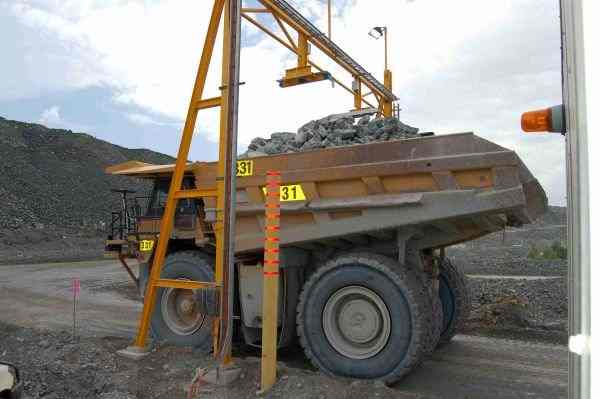
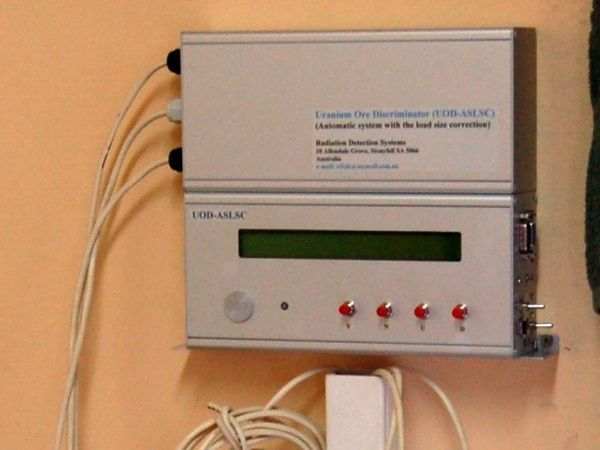
The Uranium Ore Discriminator measures the gamma radiation emitted by a uranium ore truck load and establishes the average uranium ore grade on the truck so uranium ore could be stockpiled more accurately within a required uranium ore grade range.
As truck load tonnage differs from truck to truck the distance monitoring probe is used to correct the measured gamma count rate for the distance between the gamma detector and the top surface of the uranium ore load. Therefore, the UOD-ASLSC is more accurate than conventional UODs.
General operation:
The RDS uranium ore discriminator (UOD) is based on the detection of the gamma radiation emitted by the truck load of uranium ore. The gamma detection system consists of eight independent gamma detection units (four left GDUs and four right GDUs). The gamma detectors in each GDU are shielded by lead to minimize the local gamma background.
The Discriminator Control Panel (DCP) displays the gamma count of the four left and four right GDUs in 10s, 20s or 30s counting windows and the measured average U3O8 concentration. The ore grade is calculated from the net truck gamma count (the left GDU and the right GDU background counts that are programmed into the DCP memory are automatically subtracted from the left GDU and the right GDU 'truck' signal counts).
Trucks haul different loads of U-ore and thus the distance from the top of the U-ore load to the GDUs is different from truck to truck ie the measured gamma count rate is affected by the distance of the top of the load from GDUs. The computer modeling was used to obtain the function describing the dependence of the gamma count rate on the distance of the load from the GDUs. The ultrasonic distance monitoring probe, which is incorporated into the system, measures the distance between the top surface of the U-ore load and the GDUs so the measured count can be corrected and the uranium ore grade on each truck could be estimated more accurately.
When the truck parks on the pad under the GDUs the truck driver pushes the button on a panel inside the truck cabin. This initiates the gamma counting. When the counting is finished the DCP displays the total left and right count as well as the estimated ore grade. The truck number, the ore grade (%U3O8) and the ore grade cut-off are reported via radio connectivity to the operator room and to the truck driver.
Technical parameters:
Operational parameters of the UOD with 16 GRDs:
- Lowest limit of detection (depends on the gamma background of the UOD pad) typically 20 ppm U3O8
- Maximum measured ore grade about 90,000 ppm U3O8
- Accuracy of the measured ore grade 1 better than +/- 5 %
- The RDS UOD is nearly temperature independent between -10 Co and + 50 Co.
Uranium Ore Discriminator (UOD-SAS)
(Semi-automatic system)The Uranium Ore Discriminator measures the gamma radiation emitted by a uranium ore truck load and establishes the average uranium ore grade on the truck so uranium ore could be stockpiled more accurately within the required uranium ore grade range.
General operation
The RDS uranium ore discriminator is based on the detection of the gamma radiation by two independent Gamma Detector Units (GDUs) situated approximately 1 – 1.3 m from both sides of the uranium ore truck tray. Each GDU contains 3 – 4 pairs of lead shielded gamma radiation detectors (GRDs) coupled with high voltage/amplifier boards. It has been estimated by computer modeling that the maximum error due to an incorrect parking of the truck is approximately +/- 6 %. Provided the truck with uranium ore parks closer to one GDU its higher gamma count is compensated for by the lower count of the second GDU that is situated further from the side of the truck tray.
The Discriminator Control Panel (DCP) can process the gamma count of up-to 4 left and 4 right pairs of GRDs in 10 s, 20 s or 30 s counting windows. The counts of the Left and Right GDUs (CL and CR respectively) are displayed separately on the bottom line of the DCP. The measured average U3O8 concentration is displayed on the top line and is calculated from the net left and right truck gamma count (the left GDU and the right GDU background counts are programmed into the DCP memory and are automatically subtracted from the total left GDU and the right GDU 'truck' signal counts).
The DCP and a PC in the control room communicate via a radio. When the truck stops between GDUs the truck driver reports by radio to the operator. The operator enters the truck number into the spread sheet and starts counting. When the count is finished the DCP reports the total count and the assessed ore grade to the PC. The operator directs the truck driver by the radio where the uranium ore load is to be dumped.
The discriminator has 10 programmable uranium ore grade cutoffs. The DCP and 2 GDUs are powered by a 12 V acid gel battery coupled with a solar panel.
Mining Plant Uranium Ore Discriminator (MPUOD)
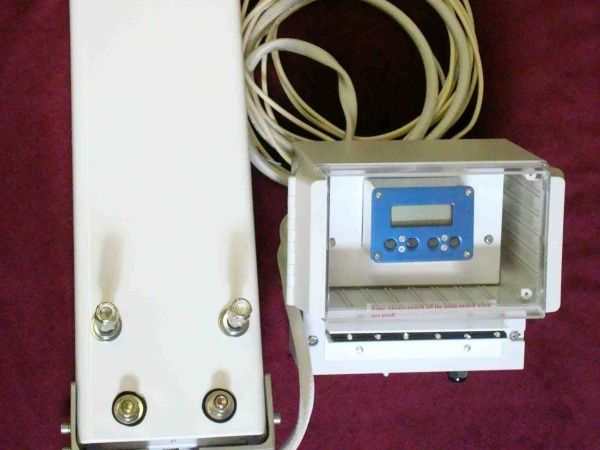

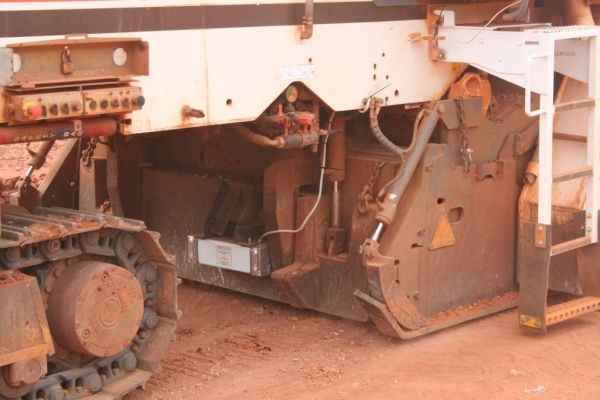
The Mining Plant Uranium Ore Discriminator (MPUOD) has been developed for the selective mining of surface uranium ore deposits. The MPUOD identifies ore, which ore grade is above the selected ore grade threshold, so such ore could be selectively mined and loaded onto a truck.
General operation:
The MPUOD detects of the gamma radiation by a Gamma Detector Unit (GDU) that is situated in front of the blade of the mining plant. The GDU detects the gamma radiation that is emitted from a 2 m wide 'strip' of ore. The GDU contains one pair of shielded gamma radiation detectors (GRDs) coupled with a high voltage/amplifier board.
The total gamma count is processed by a micro controller based Discriminator Control Panel (DCP) that is situated inside the mining plant operator cabin: The gamma pulses are counted in the 1, 2, 3, 4 or 5 min counting window, the background count is subtracted from the total count and the net count is multiplied by the count rate to the ore grade conversion factor. The average U3O8 grade (ppm) is displayed on the LCD.
The MPUOD has 5 uranium Ore Grade Thresholds (OGs) (the OGs are programmed by four momentary switches below the LCD of the DCP).
For the simplicity of the operation 5 OGs are also identified by 5 different color LEDs. The operator reports by a radio to a truck driver the 'color' of ore grade that was loaded and the truck driver dumps ore on the stockpile that has the same color coding.
In order to increase the mining rate it is recommended to use the MPUOD in association with the RDS GPS U-Grade Survey Monitor (UGSM). The UGSM is used to 'map' the ore grade of the surface of the uranium orebody. The iso-curves of ore grades are digitized so the mining plant that is equipped with a GPS could mine uranium ore more selectively.
The GPS U-Grade Survey Monitor (UGSM)
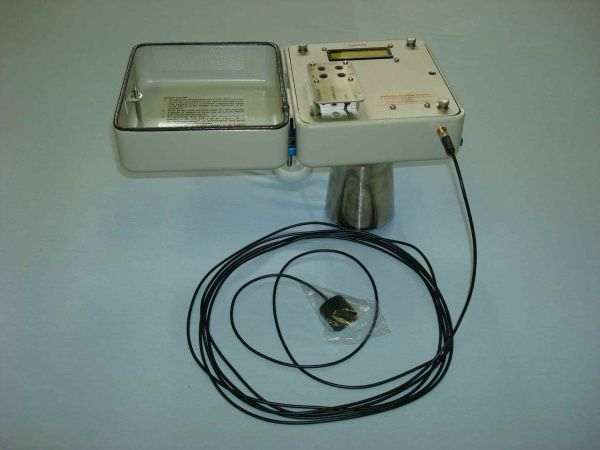
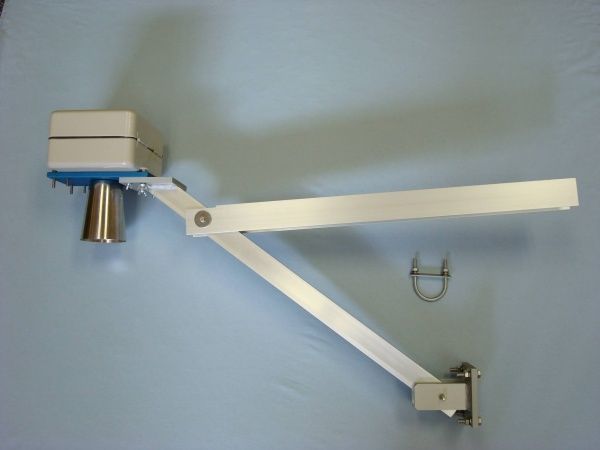
The UGSM is used to 'map' the uranium ore grade of surface uranium ore deposits. The UGSM coupled with a GPS is attached to a 4WD vehicle that drives on the surface of the flat orebody. The measured uranium ore grade is logged into the microcontroller with co-ordinates. The data log is downloaded into a MSWindows Hyperterminal and data is exported to a geophysical contouring software that is used to draw contours of ore grades.
General operation:
The UGSM is a gamma radiation survey monitor that measures the external gamma count rate (cps) by a 1" x 1" NaI(Tl) scintillation crystal housed in a lead collimated shielding that is attached to a metal arm in front of a 4WD vehicle. The UGSM measures the gamma radiation emitted from an approximately 2 m and 0.25 m deep soil or orebody disc. The gamma pulse rate is multiplied by the calibration constant (P) to convert the pulse rate to the uranium ore grade (ppm U3O8). When an external GPS antenna is connected, the reading number, the coordinates of reading positions, the count rate and the ore grade are logged into the internal memory. The distance in meters between subsequent monitoring/logging positions has to be programmed when the UGSM is in a programming mode.
Logged data can be downloaded into a MS Windows Hyperterminal as a text file that can be opened in MSExcel.
Uranium Grade Checker (UGC)
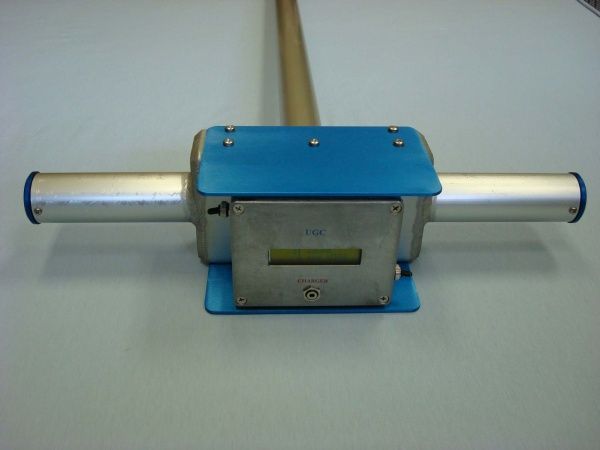
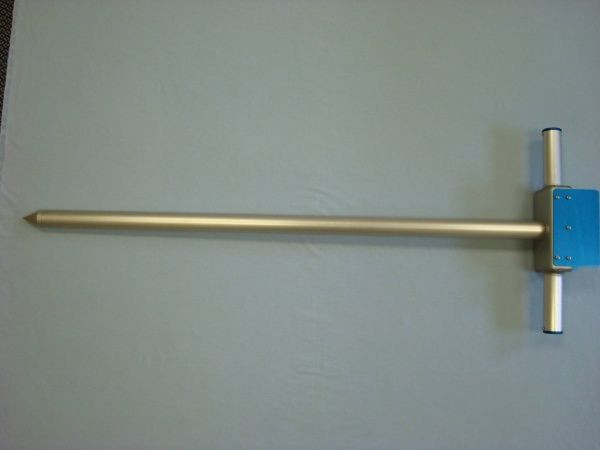
The Uranium Grade Checker (UGC) was developed to measure uranium ore grade inside drill holes in uranium deposits. The UGC can also be used to approximately estimate ore grade of piles of uranium ore.
General operation:
The UGC is a microprocessor based radiation monitor that detects the gamma radiation and the measured gamma counts are converted to uranium ore grade (ppm U3O8). The readability of the ore grade is +/- 1 ppm U3O8 and the lowest limit of detection is approximately 3 ppm U3O8. The Count Rate and Ore Grade readings are simultaneously displayed on a two line LCD either in the 2 s or the 10 s counting interval.
The UGC contains the 1.6 cm x 6.5 cm two line LCD, the pulse counter with a microprocessor coupled with the amplifier/HV power supply board, the 2,300 mAh NiMH battery and a 20.5 mm x 200 mm long GM tube inside a 1.13 m long 40 mm aluminium tube, which has a wall 6 mm thick.
The GM counter inside the aluminium tube is a 'water proof' part of the unit and the rest of the unit is rated to be 'water splash proof'.
Uranium Product Level Gauge (UPLG)
The Uranium Product level Gauge (UPLG) is used to control uranium product packaging so any spills of uranium product from 200 liter drums could be minimized.
General operation:
The uranium product is hazardous material from the radiation health and safety point of view and any clean-up of spills of uranium product that occur during packaging contribute to the occupational hazard. It is important that there is a required amount of the uranium product in steel drums. The weight of the product in the drum is monitored by electronic scales during packaging. Considering that the bulk density of uranium product varies drums with the same volume of the product may have different mass. This is one of the reasons why spills happen.
The RDS UPLG was designed to minimize the number of spills.
The RDS UPLG is based on the detection of the soft gamma radiation emitted by the uranium product. The gamma radiation is detected by the lead shielded collimated 'Gamma Probe' situated at the outside wall of the steel drum. When the 'Gamma Probe' detects the product surface at the dangerous level in the steel drum the red light will be switched on, the buzzer will be activated and the UPLG will shut down the packaging system.
Radiometric Belt Scanner (RBC)
The Radiometric Belt Scanner (RBS) measures the uranium ore grade on the main uranium plant conveyor belt and reports the ore grade to the control room.
General operation:
In order to optimize the uranium mill metallurgy process it is paramount to control the uranium ore grade that goes to the plant. The RDS RBS is a microprocessor based radiation monitor that detects the gamma radiation emitted by uranium ore on the main plant conveyor belt. The measured gamma count is converted to uranium ore grade (ppm U3O8) and displayed on a two line LCD either in 1, 2 or 3 minute counting intervals.
The RBS contains a two line LCD, the pulse counter with a microprocessor, the amplifier/HV power supply board and a 20.5 mm x 200 mm long GM tube inside a water proof lead shielded enclosure.
The readability of the ore grade is +/- 1 ppm U3O8 and the lowest limit of detection is approximately 10 ppm U3O8. As the amount of ore on the belt is continuously monitored by electronic scales the gamma count rate is logged and transmitted by radio to the PC in the control room only if ore mass on the belt is within a required mass range.